
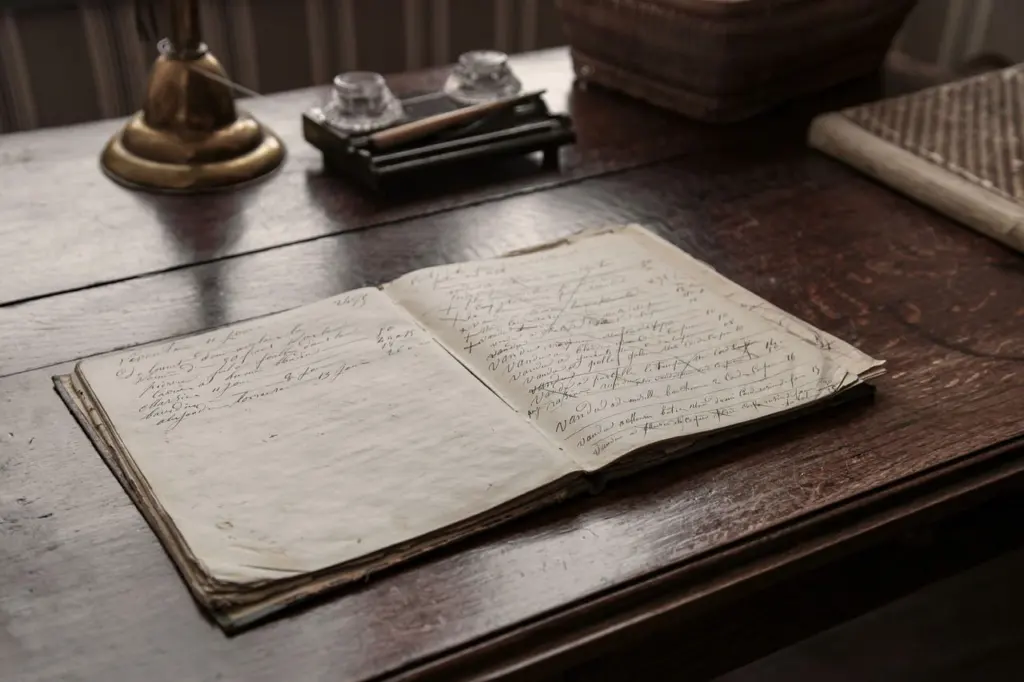
The Simone Weil notebooks, known in French as the Cahiers (notebooks), are the private working books in which the philosopher kept reading notes, speculation and drafts. They were not written for publication, and they reach English readers through several translations and selections.
This guide explains what the notebooks contain, how the French and English editions differ and how to approach them. It belongs to the wider simone weil books guide, which maps her major titles.
What the notebooks are
According to the French reference article on the Cahiers, Weil filled 18 notebooks with notes and reflections on philosophy, politics, history, science, literature and above all religion and spirituality. The same article describes modest ruled student notebooks, with a few hard-covered ones, whose covers carry geometric figures and quotations in Sanskrit, ancient Greek, Latin and German. The manuscripts are held in the Simone Weil collection of the Bibliothèque nationale de France, and the article says they were not intended for publication.
That status shapes how they read. The entries are sketches, questions and fragments, not finished arguments. The publisher of the English edition describes the notebooks as among the very few unedited personal writings of Weil’s that survive, and says they give context to her famous works and show a philosophy in development.

The notebooks also show Weil’s own view of philosophy at work. In one entry quoted by the Stanford Encyclopedia of Philosophy, she wrote that “Philosophy (including problems of cognition, etc.) is exclusively an affair of action and practice.” The notebooks are where she tried that practice out on paper.
How the notebooks are organised
The notebooks are usually named by the place where they were filled. The French reference article says the first notebook mostly holds reading notes and drafts for an essay on the causes of liberty and social oppression. It groups the next set as the Marseille notebooks, then the New York notebooks, and the last as the London notebook. The same article notes that the start of the New York series still contains notes written in Marseille.
The Stanford Encyclopedia of Philosophy confirms the pattern in its biography: it says that in New York, as in Marseilles, she filled notebook after notebook with philosophical, theological and mathematical considerations. Readers should expect the entries to move quickly between religion, Greek texts, mathematics and politics, sometimes within a page.
Some recurring terms appear in the notebooks, including metaxu, the Greek word for “intermediaries” that the Stanford entry says she used in her notebooks to describe how beauty, tradition, law and labor bring people into contact with reality. The notebooks are also where themes covered elsewhere on this site, such as attention and decreation, are worked out in rough form.
- Weil on philosophy as practice: quote
- Weil notebook entry on reading: quote
- Notebooks filled in New York and Marseilles: notebook after notebook
- metaxu in her notebooks: metaxu
- metaxu examples: beauty, cultural traditions, law, labor
The French Cahiers and the critical edition
The French notebooks were issued in stages. The French reference article says they were published from 1950 in several volumes by two publishers, Plon and Gallimard, and that a critical edition in four volumes appeared in tome VI of the Gallimard Œuvres complètes (complete works), between 1994 and 2006.
The Gallimard catalogue lists the first volume of that edition as tome VI, volume 1, covering the notebooks from 1933 to September 1941, with a publication date in 1994. Its presentation says the new edition is both chronological and exhaustive and includes previously unpublished texts on the period between the pre-war years, the exodus and the move to Marseille.
The catalogue entry for the third volume, La Porte du transcendant, describes five notebooks that outline what it calls a religious anthropology, with analogies that favor mathematics, and an index of concepts.
The notebooks in English
The first English version is listed in the Stanford Encyclopedia’s bibliography as The Notebooks of Simone Weil, translated by Arthur Wills in 1956 in two volumes and published in New York by G. P. Putnam’s Sons. Routledge later reissued it, and its catalogue page says the work was originally published posthumously in two volumes and now appears as a single reissue of 656 pages.
A second English selection is First and Last Notebooks, translated by Richard Rees and published by Oxford University Press in 1970, according to the same bibliography. Because the two English books select and arrange the material differently, page references to Weil’s notebooks depend on which edition a writer used.
For a gentler start than either English edition, the guide to a simone weil reader compares anthologies that draw on her essays and letters as well as notebook passages.
Gravity and Grace and the question of editing
The best-known book drawn from the notebooks was not arranged by Weil. The Routledge page for Gravity and Grace says that Gustave Thibon, the farmer to whom she had entrusted her notebooks, compiled a compendium of her writings, and the Stanford bibliography gives the French title as La pesanteur et la grâce, published in Paris by Plon in 1947.
This matters for reading. A selection arranged by theme presents Weil in polished, quotable form, but it reflects an editor’s choices about what to include and how to group it. Readers who meet a famous line from Gravity and Grace and then look for it in the chronological Cahiers may find it embedded in a longer, less settled passage. How much weight to give Thibon’s arrangement is a matter on which scholars and readers differ, and the critical edition exists partly to let readers judge for themselves.
The same caution applies to the other posthumous books. The book-length political work she wrote in London is covered in the guide to the need for roots, and it is a different kind of text from the notebooks.
How to read the notebooks
The French reference article suggests reading the notebooks in parallel with the texts Weil wrote in the same period, since they supply the metaphysical and spiritual background of her essays on current events. That is a practical approach: take one finished essay or letter, then read the notebook entries from the same months.
A few habits help. Treat each entry as a note to herself, not a thesis. Notice when she is quoting a source and when she is thinking aloud. Follow a single theme across several entries before drawing conclusions. The Stanford entry quotes one entry that shows her method: “To read necessity behind sensation, to read order behind necessity, to read God behind order.” Passages like this are best read slowly, with attention to the whole sequence of the sentence.
The French reference article describes the notebooks as holding speculative or theoretical sketches that were never completed. A line from them should therefore be attributed to the notebook it comes from and not presented as a settled statement of her position.
Frequently asked questions
What are the Simone Weil notebooks?
Show answer
They are the private notebooks in which Weil recorded reading notes, drafts and reflections. They are known in French as the Cahiers and were not intended for publication.
Which English edition should a newcomer try first?
Show answer
The Wills translation of The Notebooks of Simone Weil is the longer English selection, and First and Last Notebooks by Rees is the other. A reader new to Weil may find an anthology easier to begin with.
Is Gravity and Grace the same as the notebooks?
Show answer
No. It is a thematic compilation made by Gustave Thibon from material she left with him, not a chronological edition of the notebooks.
Where are the original notebooks kept?
Show answer
According to the French reference article, the manuscripts are held in the Simone Weil collection of the Bibliothèque nationale de France.